Month: November 2025

CPB #10: Danger at the Threshold: Mina Harker and Victorian Moral Anxieties

Quotation from Dracula (Ch. 26)

“When I came in, Mina was sitting by the fire, asleep. She looked tired and pale, but she made a gallant effort to be bright and cheerful. It was apparent, however, that her strength was failing; for she soon lapsed into a doze.

When I came close to her she woke with a start, and a look of fear, as though she had been dreaming of some terrible thing. She looked at me in a strange, puzzled way, as though trying to remember something, but could not quite get it.”

My Observation

Mina’s wavering identity — torn between herself and Dracula’s influence — shows how Stoker uses her body and mind as a battleground for purity versus corruption. The men fear not just losing her, but losing her moral essence. Their frantic coordination across Europe reflects a Victorian belief that law, science, and masculine authority must intervene to protect endangered women.

Historical Connection: The 1885 ‘White Slavery’ Panic & the Criminal Law Amendment Act

In the real world, the British public experienced a similar anxiety during the 1885 “white slavery” panic. W.T. Stead’s exposé claimed that foreign criminals were abducting English girls, which ignited nationwide fear about women being “contaminated” or morally ruined by outsiders. Parliament responded with emergency legislation to “protect” women’s purity.

Both the novel and the historical event show Victorian society’s fear that women’s bodies were vulnerable sites of invasion — whether by criminal traffickers or, in Stoker’s fiction, a foreign supernatural threat. Mina’s loss of control, like the girls described in Stead’s articles, reflects how the era projected national anxieties about sexuality, purity, and foreign influence onto women.

Reflection

This parallel shows how Dracula taps into real Victorian fears about outside threats endangering English womanhood. Mina’s transformation isn’t just a horror device — it mirrors a culture that believed modernity and morality could unravel through the violation of women. The group’s desperate pursuit of Dracula resembles how Britain scrambled to legislate morality. Stoker’s novel, shaped by the same anxieties, becomes part of a broader cultural effort to define and defend Victorian ideals of purity.
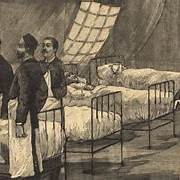
Dracula by Bram Stoker (1897)

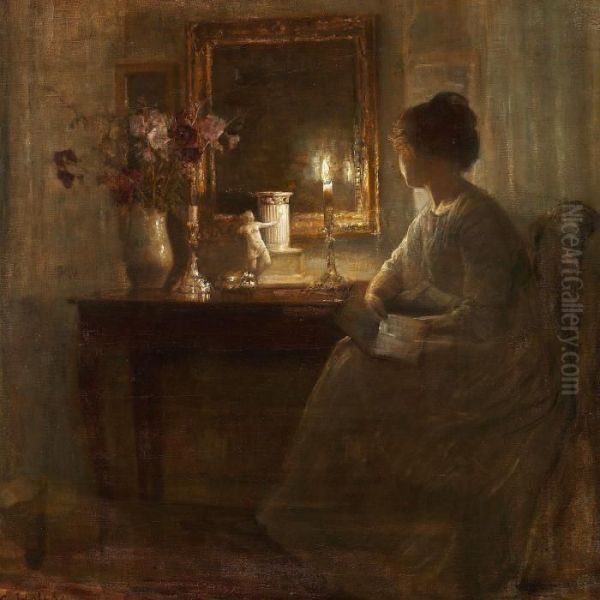
Bram Stoker’s Dracula (1897) is a classic Gothic novel about Count Dracula, a vampire who comes from Transylvania to England. The story is told through diaries, letters, and newspaper articles, which makes it feel really immediate and suspenseful. It mixes old-school superstition with Victorian science, like blood transfusions, and explores themes like illness, fear, and women’s vulnerability. Even over a hundred years later, it’s creepy, intense, and shows the anxieties of Victorian society in a way that still feels relevant today.

CPB#9: Lucy’s Illness and the Russian

Historical Context: The 1889–1890 Russian Flu Pandemic

Pages 86–173

In these chapters, Dracula shifts from subtle unease to a full medical crisis. Lucy Westenra’s long decline becomes the novel’s emotional and structural center. Stoker describes her sickness with clinical detail: pallor, faintness, rapid pulse changes, difficulty breathing, and sudden nighttime episodes that leave her weaker each morning. What makes Lucy’s illness particularly striking is how much it resembles real medical confusion during the late 19th century.

Lucy’s Mysterious Illness (Chs. 10–12)

Chapters 10–12 focus heavily on the doctors’ attempts to understand Lucy’s deteriorating condition. Seward and Van Helsing record her symptoms carefully, yet neither can diagnose the cause. Stoker repeatedly emphasizes how modern medicine fails: each blood transfusion revives Lucy temporarily, only for her condition to worsen again by the next night.

This mirrors the broader uncertainty of Victorian medicine during the Russian Flu pandemic (1889–1890), when physicians across Europe were grappling with symptoms they did not recognize and could not stop. Like Lucy, many patients appeared healthy, collapsed suddenly, revived briefly, and then worsened again.

Blood, Breath, and Medical Fear

The panic around Lucy’s blood loss parallels the real-world panic over the pandemic’s respiratory attacks. Both the novel and the real event deal with fears of unseen, night-moving forces that drain life without clear explanation. In the 1889 pandemic, newspapers described the flu as “a thief in the night,” language that feels remarkably similar to the way Van Helsing conceptualizes Dracula’s attacks.

Science Fails to Provide Answers

In both the novel and the Russian Flu crisis, doctors rely on emerging but incomplete science. Blood transfusion was cutting-edge in the 1890s, just as new germ theories were transforming medicine after the pandemic. Yet Stoker shows how modern treatments cannot protect Lucy from a force beyond scientific understanding — much like the real physicians who admitted their tools were insufficient against the mysterious influenza.

Public Fear and the “Unseen Threat”

Just as Londoners feared the flu’s invisible spread, the townspeople in the novel begin reporting a strange “bloofer lady” abducting children. This expansion of fear from the private sickroom to the public sphere reflects how a single case of illness could ripple outward, destabilizing entire communities.

CPB #8 Hidden Dangers in Victorian London: The Beetle and the Jack the Ripper Murders

Real-world example:
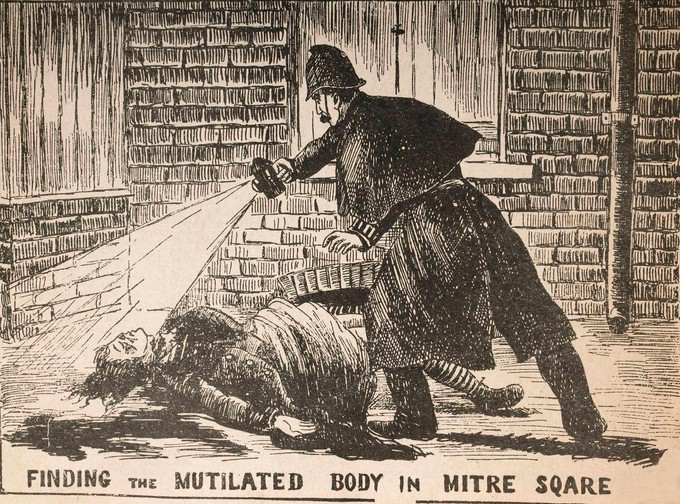
A real-world event that connects closely to The Beetle is the Jack the Ripper murders of 1888 in London. These killings created widespread terror throughout the city because the murderer’s identity was unknown and his crimes took place in dark, ordinary urban spaces. Similarly, The Beetle features a mysterious, predatory figure who moves unseen through London and preys upon unsuspecting victims. Both the novel and the murders expose late-Victorian fears about the hidden dangers of city life and the possibility that evil could exist within the very heart of modern civilization. The public panic and fascination surrounding the Ripper case mirror the novel’s atmosphere of paranoia, secrecy, and moral corruption.

Supporting passage from The Beetle:

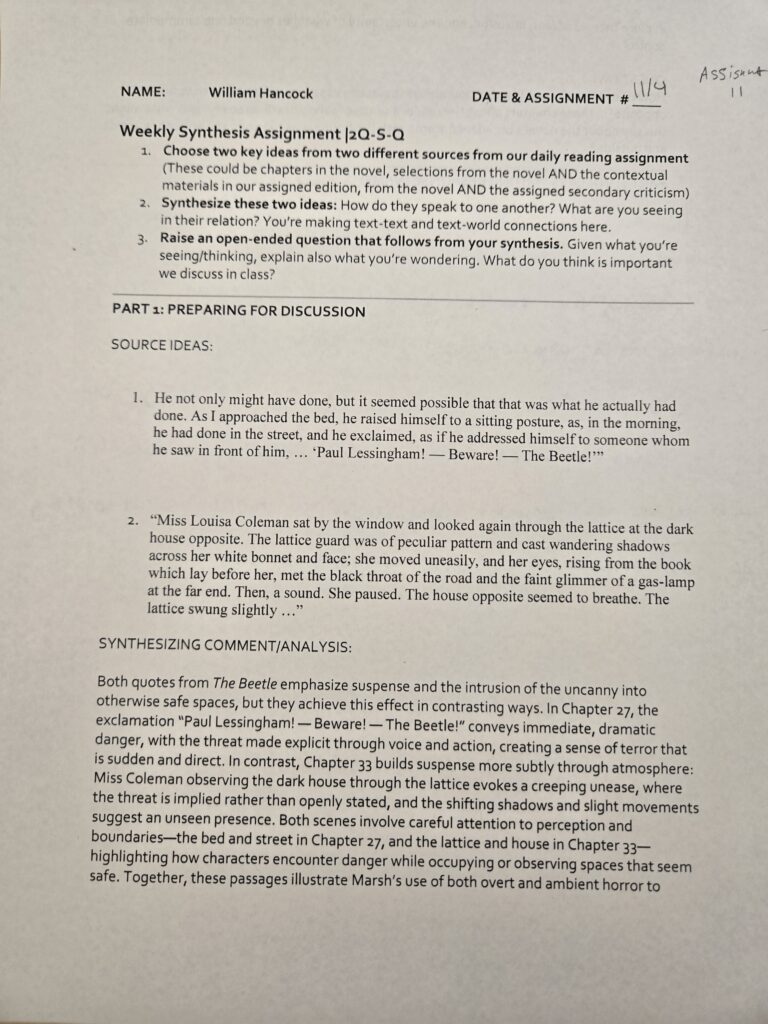
“London at night is a queer place, a very queer place – full of strange sounds, and stranger shadows, one never knows what may be lurking in the next street.” (chapter 10)

This passage reflects the same mood of uncertainty and menace that gripped London during the Ripper murders. The city is portrayed as a space where ordinary safety dissolves into fear, echoing how the real events of 1888 shattered the illusion of control in a modern, supposedly civilized metropolis.

© 2026 William Hancock

Theme by Anders NorenUp ↑

css.php