Final CPB Reflection

Final CPB Reflection

Tom Standage suggests that keeping a commonplace book is a form of self-definition: the material a person chooses to record becomes an expression of their values, curiosities, and intellectual habits. After reviewing my CPB entries from the semester, I see clearly how the passages I selected and the historical connections I made reveal the patterns of my thinking. My commonplace book does more than document the texts we studied; it reflects my instinct to connect fictional moments to real-world questions of power, justice, fear, and human behavior.


Historical Patterns and Literary Connections

One of the strongest patterns in my CPB is my consistent focus on historical and social contexts. Nearly every entry extends beyond the novel into the world that produced it. For Jane Eyre, I focused on Victorian child labor and drew from historical information about children’s working conditions.


“I resisted all the way… I felt resolved… to go all lengths.”
Jane Eyre (Brontë)

This led me to consider how real nineteenth-century children also pushed back against unjust authority.

When working with Frankenstein, I selected Victor’s memory of the lightning-struck oak “nothing remained but a blasted stump… reduced to thin ribbons of wood” and connected it to Luigi Galvani’s experiments with “animal electricity.”
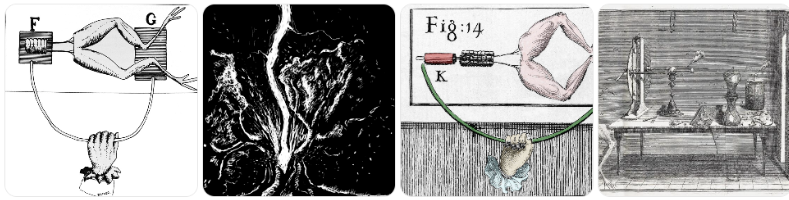
Here, the visual reinforces the connection between lightning, electricity, and Victor’s scientific obsession.


Autonomy and Moral Agency Across Texts

Jane Eyre’s declarations of independence appear throughout my CPB. In CPB #4, her famous assertion “I am no bird; and no net ensnares me: I am a free human being with an independent will”—became the foundation for connecting the novel to real historical women who faced barriers but acted with similar courage.
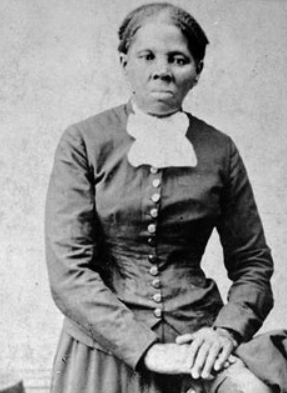
These figures echo Jane’s defiance and reinforce my focus on autonomy and integrity.

My entries on Dracula also emphasize autonomy, particularly Mina’s struggle as she becomes psychologically entangled with Dracula’s influence.
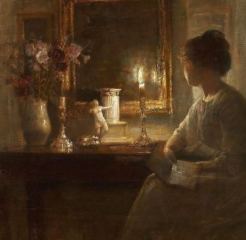
Jonathan describes one moment of her slipping identity: “She looked at me in a strange, puzzled way…” a detail that reflects the era’s anxieties about moral contamination.


Three Defining CPB Entries

A few entries best represent my overall reading identity. The first is the Jane Eyre entry featuring her insistence on equality “equal—as we are!” which I paired with historical accounts of women’s activism.

The second is my Jekyll and Hyde entry, where I explored the “primitive duality of man” and connected it to Victorian debates about criminal insanity and the limits of legal responsibility.
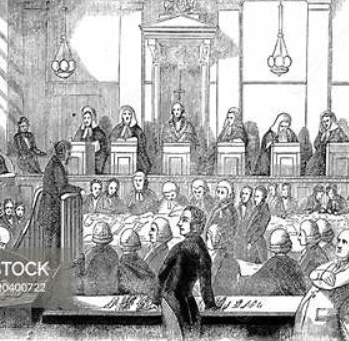
The courtroom image visually strengthens the comparison between Hyde’s transformation and real courtroom struggles over mental state and culpability.

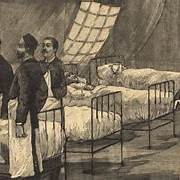
The final defining entry is my analysis of Lucy Westenra’s mysterious illness, whose symptoms “paleness, faintness… weaker each morning” mirror historical accounts from the 1889–90 Russian Flu pandemic.
“paleness, faintness… weaker each morning”
Dracula (Stoker)

These entries show how I use history to deepen my interpretations of fear, vulnerability, and public anxiety.


The CPB’s Impact on My Reading

Keeping a commonplace book changed my reading process. I paused more often, asked more questions, and looked outward to cultural contexts. When Victor encounters the blasted tree, I didn’t only appreciate the imagery; I asked what it meant for his moral responsibility. When Dorian realizes “It was his beauty that had ruined him,” I connected that idea to historical scandals around secrecy and image-making.

My QCQs fed into this reflection process. The questions I raised about Mina’s corruption, Jekyll’s moral responsibility, or Dorian’s obsession with appearances became the foundation for deeper research in my CPB entries. The QCQs served as seeds, and the CPB allowed them to grow into fully developed analyses.


Future Directions and Intellectual Identity

Looking ahead, the themes that emerged in my CPB suggest clear avenues for future research, including Victorian science, gender roles, and imperial anxieties.
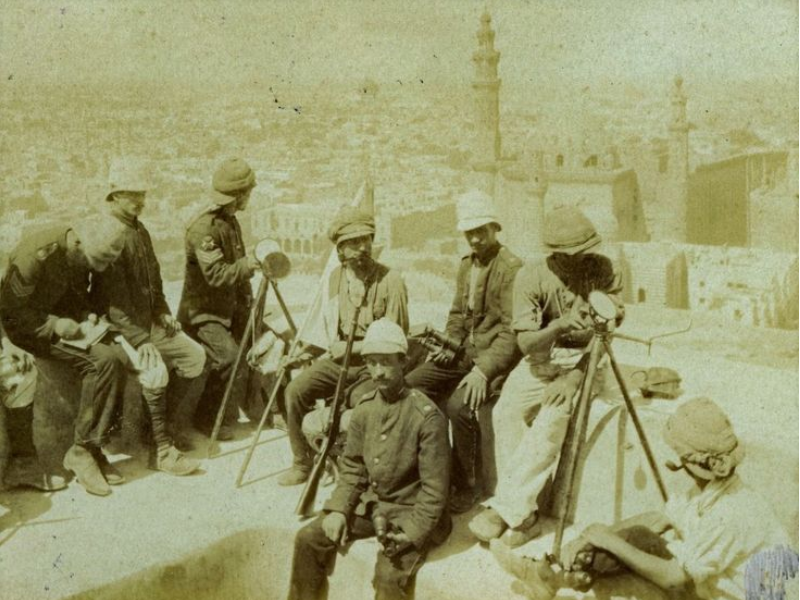
This image works well in the section discussing imperialism and future research possibilities.

Ultimately, my commonplace book serves precisely the purpose Standage describes it reveals who I am as a reader. The passages I selected, the historical frameworks I explored, and the questions I asked all point toward a reader interested in the intersections of literature, culture, power, and ethics. My CPB is more than a record, it is a portrait of my intellectual identity.


Works Cited

Brontë, Charlotte. Jane Eyre. 1847.
Shelley, Mary. Frankenstein. 1818 ed.
Stevenson, Robert Louis. The Strange Case of Dr. Jekyll and Mr. Hyde. 1886.
Stoker, Bram. Dracula. 1897.
Wilde, Oscar. The Picture of Dorian Gray. 1890.

“Elizabeth Blackwell.” Britannica.
“Harriet Tubman.” National Park Service.
“Charlotte Brontë.” Wikipedia.
“Cleveland Street Scandal.” British Library.
“Oscar Wilde: The Trials of 1895.” BBC History.
General summaries of:
— Luigi Galvani’s experiments
— M’Naghten Rules (19th-century criminal insanity)
— 1889–90 Russian Flu pandemic
— 1885 “White Slavery” panic (W. T. Stead)
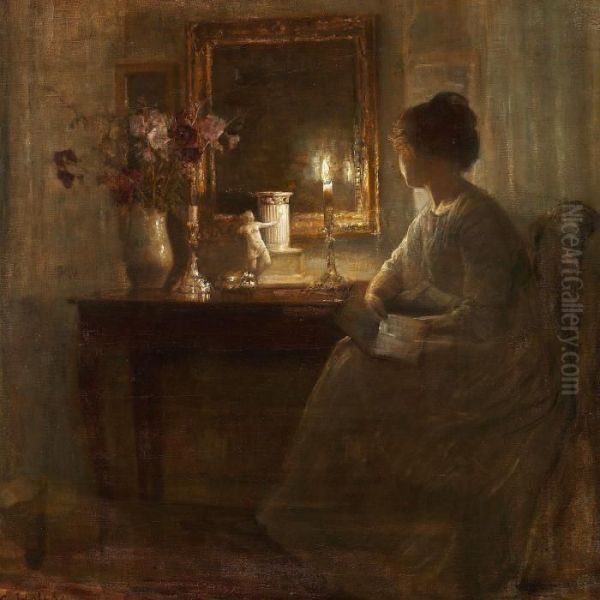
CPB #10: Danger at the Threshold: Mina Harker and Victorian Moral Anxieties

Quotation from Dracula (Ch. 26)

“When I came in, Mina was sitting by the fire, asleep. She looked tired and pale, but she made a gallant effort to be bright and cheerful. It was apparent, however, that her strength was failing; for she soon lapsed into a doze.

When I came close to her she woke with a start, and a look of fear, as though she had been dreaming of some terrible thing. She looked at me in a strange, puzzled way, as though trying to remember something, but could not quite get it.”

My Observation

Mina’s wavering identity — torn between herself and Dracula’s influence — shows how Stoker uses her body and mind as a battleground for purity versus corruption. The men fear not just losing her, but losing her moral essence. Their frantic coordination across Europe reflects a Victorian belief that law, science, and masculine authority must intervene to protect endangered women.

Historical Connection: The 1885 ‘White Slavery’ Panic & the Criminal Law Amendment Act

In the real world, the British public experienced a similar anxiety during the 1885 “white slavery” panic. W.T. Stead’s exposé claimed that foreign criminals were abducting English girls, which ignited nationwide fear about women being “contaminated” or morally ruined by outsiders. Parliament responded with emergency legislation to “protect” women’s purity.

Both the novel and the historical event show Victorian society’s fear that women’s bodies were vulnerable sites of invasion — whether by criminal traffickers or, in Stoker’s fiction, a foreign supernatural threat. Mina’s loss of control, like the girls described in Stead’s articles, reflects how the era projected national anxieties about sexuality, purity, and foreign influence onto women.

Reflection

This parallel shows how Dracula taps into real Victorian fears about outside threats endangering English womanhood. Mina’s transformation isn’t just a horror device — it mirrors a culture that believed modernity and morality could unravel through the violation of women. The group’s desperate pursuit of Dracula resembles how Britain scrambled to legislate morality. Stoker’s novel, shaped by the same anxieties, becomes part of a broader cultural effort to define and defend Victorian ideals of purity.

Dracula by Bram Stoker (1897)

Bram Stoker’s Dracula (1897) is a classic Gothic novel about Count Dracula, a vampire who comes from Transylvania to England. The story is told through diaries, letters, and newspaper articles, which makes it feel really immediate and suspenseful. It mixes old-school superstition with Victorian science, like blood transfusions, and explores themes like illness, fear, and women’s vulnerability. Even over a hundred years later, it’s creepy, intense, and shows the anxieties of Victorian society in a way that still feels relevant today.

CPB#9: Lucy’s Illness and the Russian

Historical Context: The 1889–1890 Russian Flu Pandemic

Pages 86–173

In these chapters, Dracula shifts from subtle unease to a full medical crisis. Lucy Westenra’s long decline becomes the novel’s emotional and structural center. Stoker describes her sickness with clinical detail: pallor, faintness, rapid pulse changes, difficulty breathing, and sudden nighttime episodes that leave her weaker each morning. What makes Lucy’s illness particularly striking is how much it resembles real medical confusion during the late 19th century.

Lucy’s Mysterious Illness (Chs. 10–12)

Chapters 10–12 focus heavily on the doctors’ attempts to understand Lucy’s deteriorating condition. Seward and Van Helsing record her symptoms carefully, yet neither can diagnose the cause. Stoker repeatedly emphasizes how modern medicine fails: each blood transfusion revives Lucy temporarily, only for her condition to worsen again by the next night.

This mirrors the broader uncertainty of Victorian medicine during the Russian Flu pandemic (1889–1890), when physicians across Europe were grappling with symptoms they did not recognize and could not stop. Like Lucy, many patients appeared healthy, collapsed suddenly, revived briefly, and then worsened again.

Blood, Breath, and Medical Fear

The panic around Lucy’s blood loss parallels the real-world panic over the pandemic’s respiratory attacks. Both the novel and the real event deal with fears of unseen, night-moving forces that drain life without clear explanation. In the 1889 pandemic, newspapers described the flu as “a thief in the night,” language that feels remarkably similar to the way Van Helsing conceptualizes Dracula’s attacks.

Science Fails to Provide Answers

In both the novel and the Russian Flu crisis, doctors rely on emerging but incomplete science. Blood transfusion was cutting-edge in the 1890s, just as new germ theories were transforming medicine after the pandemic. Yet Stoker shows how modern treatments cannot protect Lucy from a force beyond scientific understanding — much like the real physicians who admitted their tools were insufficient against the mysterious influenza.

Public Fear and the “Unseen Threat”

Just as Londoners feared the flu’s invisible spread, the townspeople in the novel begin reporting a strange “bloofer lady” abducting children. This expansion of fear from the private sickroom to the public sphere reflects how a single case of illness could ripple outward, destabilizing entire communities.

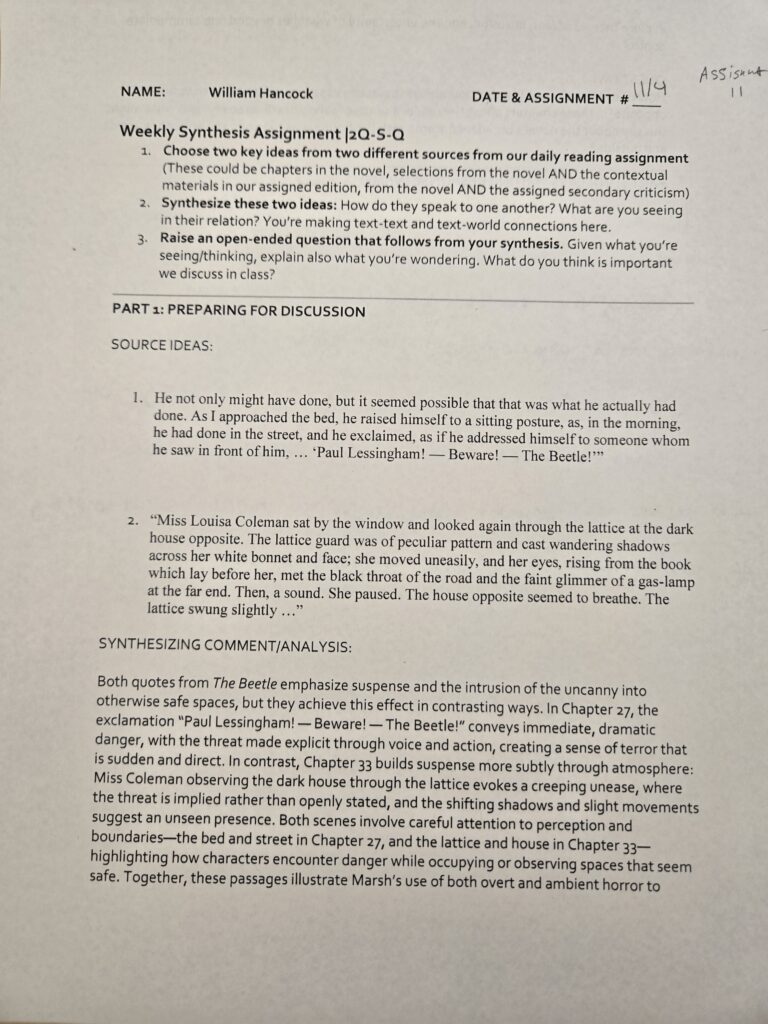
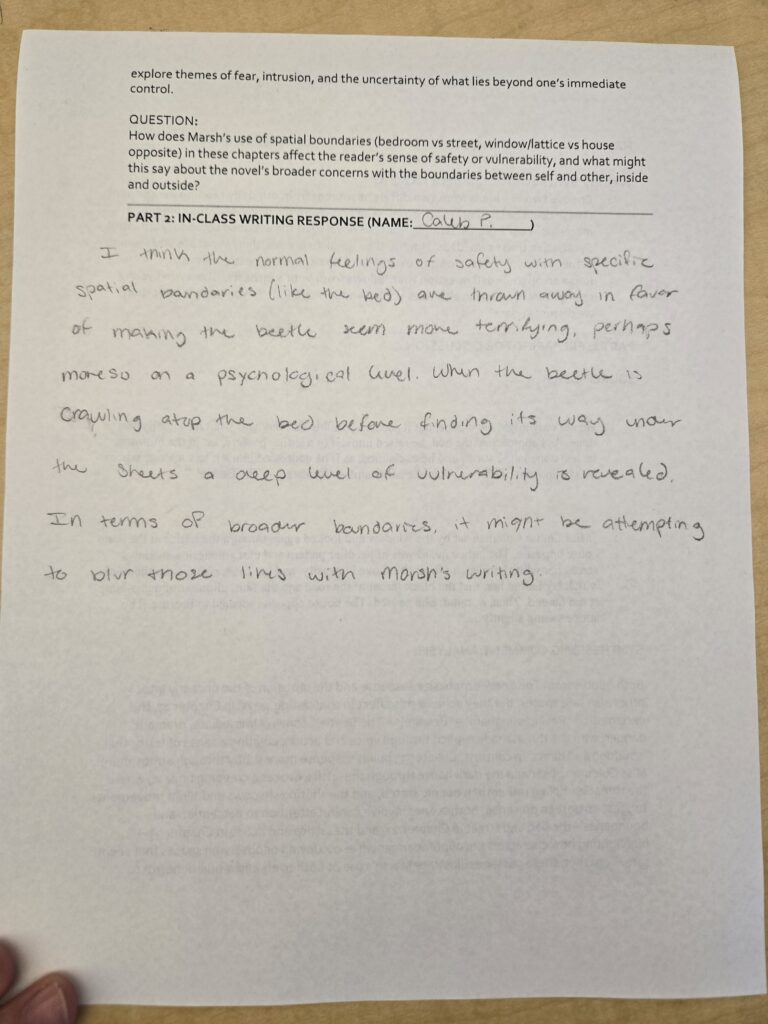
CPB #8 Hidden Dangers in Victorian London: The Beetle and the Jack the Ripper Murders

Real-world example:
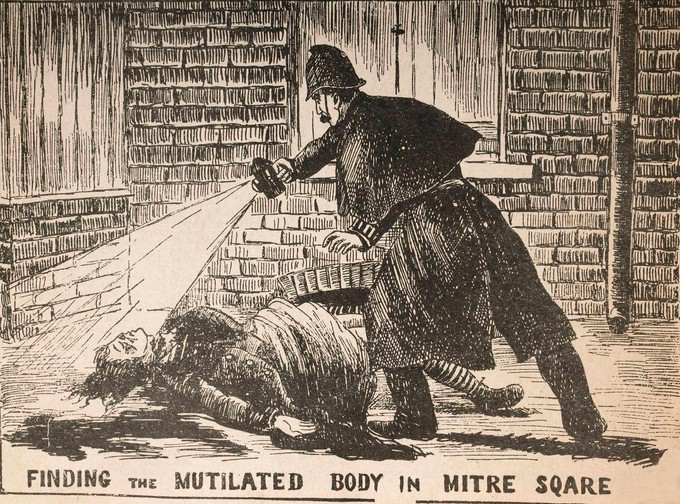
A real-world event that connects closely to The Beetle is the Jack the Ripper murders of 1888 in London. These killings created widespread terror throughout the city because the murderer’s identity was unknown and his crimes took place in dark, ordinary urban spaces. Similarly, The Beetle features a mysterious, predatory figure who moves unseen through London and preys upon unsuspecting victims. Both the novel and the murders expose late-Victorian fears about the hidden dangers of city life and the possibility that evil could exist within the very heart of modern civilization. The public panic and fascination surrounding the Ripper case mirror the novel’s atmosphere of paranoia, secrecy, and moral corruption.

Supporting passage from The Beetle:

“London at night is a queer place, a very queer place – full of strange sounds, and stranger shadows, one never knows what may be lurking in the next street.” (chapter 10)

This passage reflects the same mood of uncertainty and menace that gripped London during the Ripper murders. The city is portrayed as a space where ordinary safety dissolves into fear, echoing how the real events of 1888 shattered the illusion of control in a modern, supposedly civilized metropolis.

The Beetle by Richard Marsh (1897)

Step into the shadowy streets of Victorian London with Richard Marsh’s The Beetle, a chilling tale of mystery, obsession, and the supernatural. Published the same year as Bram Stoker’s Dracula, this novel captivated readers with its suspenseful plot, multiple narrators, and eerie, shape-shifting antagonist known only as “the Beetle.”

The Beetle weaves together themes of power, identity, and fear, blending horror, romance, and crime in a story that still unsettles modern readers. It’s a masterclass in Victorian Gothic storytelling and a hidden gem for anyone intrigued by the darker side of human—and inhuman—nature.

Whether you’re a horror aficionado, a fan of Gothic literature, or just curious about Victorian London’s mysteries, The Beetle promises a thrilling, unnerving journey you won’t forget.

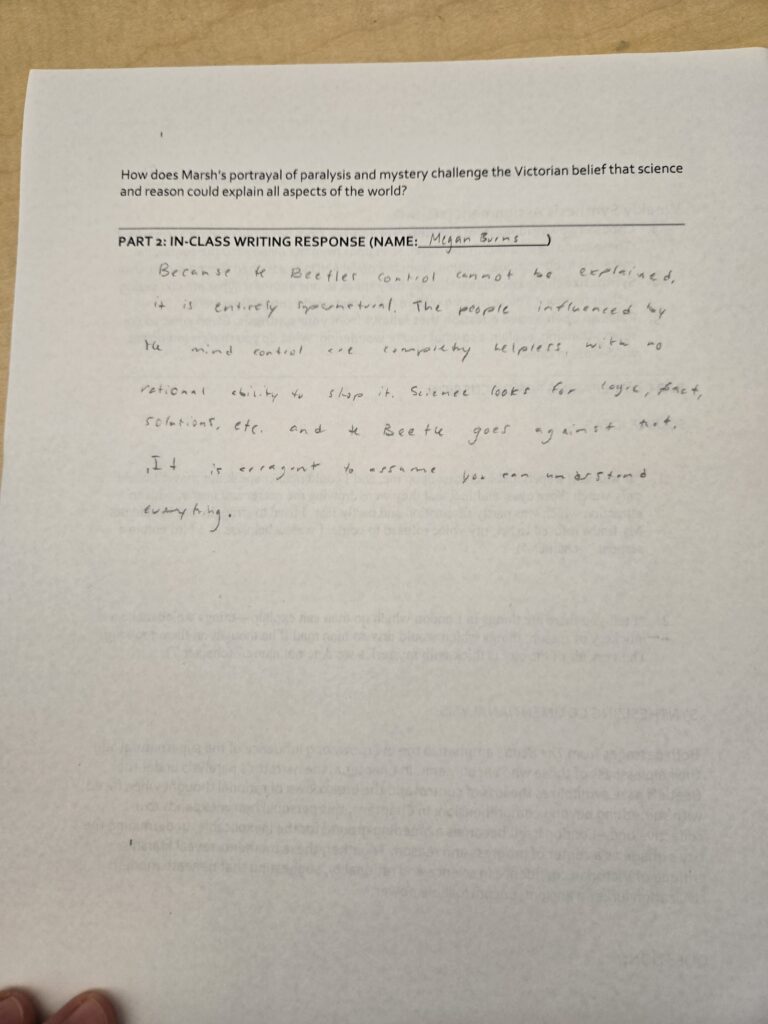
CPB#8 – Real world application of the Beetle

Real-World Application:

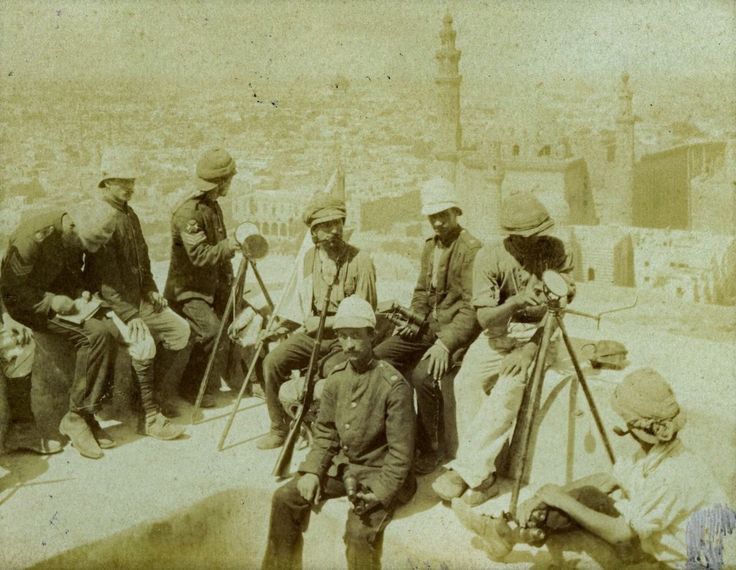
In late-Victorian Britain, anxieties surrounding empire, gender, and identity were reflected in literature that blurred the lines between science, superstition, and morality. Richard Marsh’s The Beetle: A Mystery (1897) embodies these tensions through its depiction of an Egyptian shape-shifting antagonist who uses hypnosis and transformation to control others. The novel appeared during Britain’s occupation of Egypt (beginning in 1882), when public fascination with Egyptology and fear of the “foreign other” were at their height. Scholars have linked Marsh’s story to the era’s imperial unease—its fear that the colonized might “invade” the colonizer’s body and mind.

Marsh’s personal history also adds a real-world dimension: before writing The Beetle, he served a prison sentence for forgery and later changed his name from Richard Heldmann to escape his criminal past. His fascination with disguise, duality, and guilt parallels broader Victorian debates about morality, criminal identity, and social respectability. Published the same year as Dracula, The Beetle explores similar anxieties about foreign influence, hypnosis, and moral corruption. Together, these themes capture the late 19th century’s struggle to define the boundaries between civilization and savagery, science and superstition, self and other—issues that reflected both Britain’s imperial identity and its moral uncertainties at the turn of the century.


“British troops in Cairo, 1882, marking the beginning of the British occupation of Egypt, which inspired a wave of late-Victorian fiction exploring imperial anxiety and the allure of the exotic.”

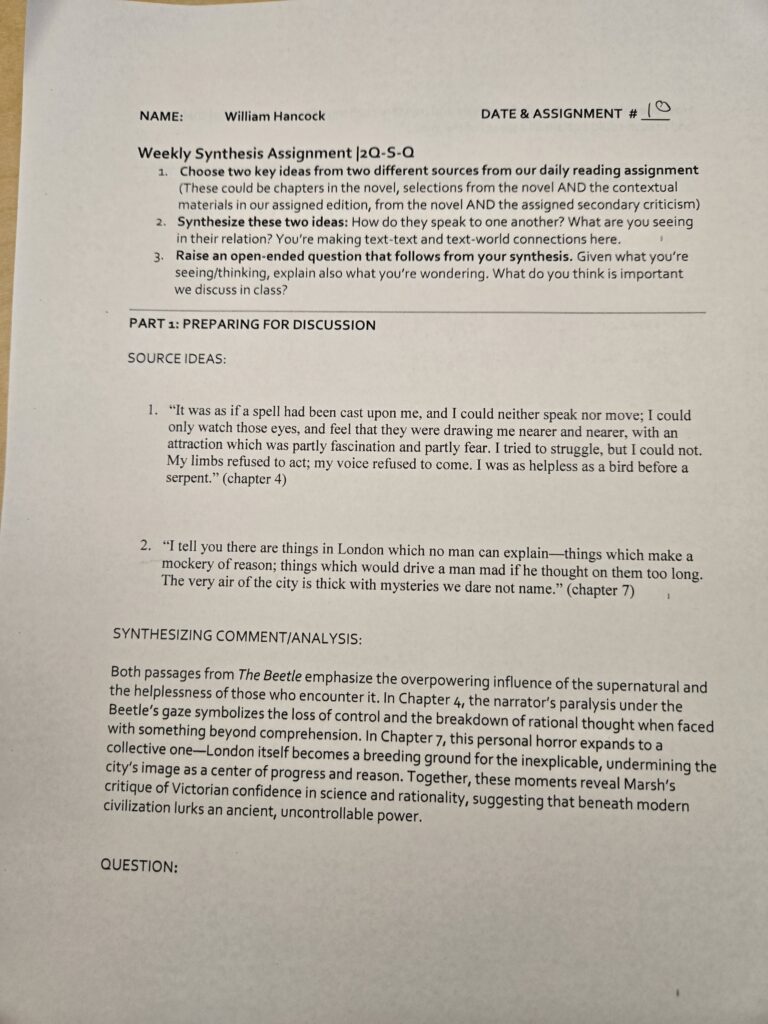
2Q-S-Q assignment 9

NAME:               William Hancock                                                      DATE & ASSIGNMENT  # ____

Weekly Synthesis Assignment |2Q-S-Q

  1. Choose two key ideas from two different sources from our daily reading assignment (These could be chapters in the novel, selections from the novel AND the contextual materials in our assigned edition, from the novel AND the assigned secondary criticism)
  2. Synthesize these two ideas: How do they speak to one another? What are you seeing in their relation? You’re making text-text and text-world connections here.
  3. Raise an open-ended question that follows from your synthesis. Given what you’re seeing/thinking, explain also what you’re wondering. What do you think is important we discuss in class?

PART 1: PREPARING FOR DISCUSSION

SOURCE IDEAS:

  1. “The only way to get rid of a temptation is to yield to it. Resist it, and your soul grows sick with longing for the things it has forbidden to itself, with desire for what its monstrous laws have made monstrous and unlawful. It has been said that the great events of the world take place in the brain. It is in the brain, and the brain only, that the great sins of the world take place also.” (chapter 2)
  • “Eternal youth, infinite passion, pleasures subtle and secret, wild joys and wilder sins—he was to have all these things. The portrait was to bear the burden of his shame: that was all. The portrait would become to him the most magical of mirrors. As it had revealed to him his own body, so it would reveal to him his own soul. And when winter came upon it, he would still be standing where spring trembles on the verge of summer.” (chapter 8)

SYNTHESIZING COMMENT/ANALYSIS:

These two passages frame Dorian’s entire moral journey. In the first, Lord Henry plants the seed of aesthetic hedonism, suggesting that denying temptation harms the soul. In the second, Dorian reaps the consequences of embracing that doctrine fully, finding freedom from guilt but also surrendering his humanity. Together, they illustrate how Wilde uses temptation and beauty as vehicles to explore corruption, influence, and the illusion of moral immunity. The evolution from idea to embodiment reveals the destructive potential of philosophies divorced from empathy and responsibility.

QUESTION:

How does Wilde use the transformation of Dorian’s beliefs—from Lord Henry’s seductive philosophy to his own lived experience—to critique the allure and consequences of living for beauty and pleasure alone?


Part 2: In-class Writing Response (NAME:__________________)

« Older posts

© 2026 William Hancock

Theme by Anders NorenUp ↑

css.php