Month: September 2025 (Page 1 of 2)

A Spirit to Spirit Conversation

Quote/Observation:
“‘I am not talking to you now through the medium of custom, conventionalities, nor even of mortal flesh: it is my spirit that addresses your spirit; just as if both had passed through the grave, and we stood at God’s feet, equal— as we are!’” – Jane Eyre, Chapter 23

Reflection/Commentary:
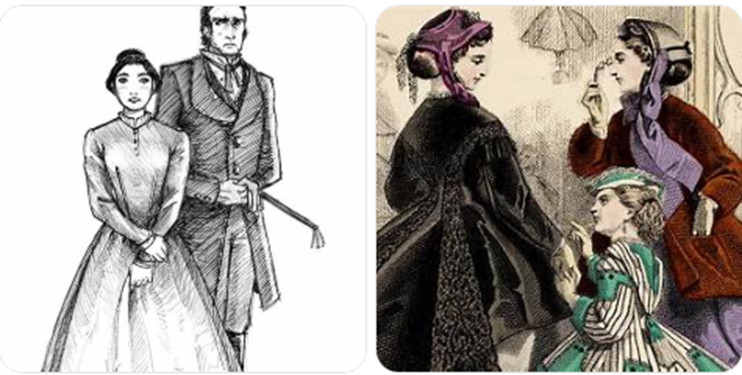
Jane’s insistence on speaking to Rochester as an equal directly challenges the strict social hierarchies of Victorian England. At that time, women were expected to be deferential to men, especially those of higher social class, and were rarely encouraged to express independent thought or moral judgment. Jane refuses to conform, asserting her intellect and principles over social expectation.

Real-World Connection: During the 19th century, women like Mary Wollstonecraft and Charlotte Brontë herself pushed against societal norms by advocating for female education, independence, and moral agency. Jane’s dialogue mirrors these real-world efforts, showing that women could claim a voice in relationships and society without abandoning their integrity. Her courage and self-respect foreshadow the gradual shift toward women’s rights that would gather momentum in the late Victorian era.

Personal Reflection: Jane’s balance of love and principle reminds me that asserting oneself does not mean rejecting affection or human connection; rather, it’s about engaging authentically and demanding respect. Even today, this lesson applies when navigating relationships where power dynamics are at play.
2Q-S-Q assignment 5

NAME: William Hancock DATE & ASSIGNMENT # _6___

Weekly Synthesis Assignment |2Q-S-Q

1. Choose two key ideas from two different sources from our daily reading assignment (These could be chapters in the novel, selections from the novel AND the contextual materials in our assigned edition, from the novel AND the assigned secondary criticism)

2. Synthesize these two ideas: How do they speak to one another? What are you seeing in their relation? You’re making text-text and text-world connections here.

3. Raise an open-ended question that follows from your synthesis. Given what you’re seeing/thinking, explain also what you’re wondering. What do you think is important we discuss in class?

PART 1: PREPARING FOR DISCUSSION

SOURCE IDEAS:

1. “I am no bird; and no net ensnares me: I am a free human being with an independent will, which I now exert to leave you. I care for myself. The more solitary, the more friendless, the more unsustained I am, the more I will respect myself.” (chapter 11)

2. “I have for the first time found what I can truly love—I have found you. You are my sympathy—my better self—my good angel: I am bound to you with a strong attachment, and I think you feel it in return. I am yours; you are my own; my soul is awake to a joy I have never known before.” (chapter 19)

SYNTHESIZING COMMENT/ANALYSIS:

Both quotes explore Jane’s self-awareness and her struggle to balance autonomy with emotional attachment. In the first quote, she emphasizes her independence and moral resolve, asserting that her self-respect and individuality come before submission to anyone else’s desires. In the second quote, she openly declares her love for Rochester, but it is framed thoughtfully—she identifies him as her “better self,” implying that her affection strengthens her rather than diminishes her autonomy. Together, these passages illustrate a recurring theme in the novel: Jane’s desire for connection must coexist with her unwavering self-respect. Brontë portrays Jane as a heroine who refuses to compromise her principles, even when facing intense emotional longing.

QUESTION:

How does Jane’s commitment to her own moral and emotional independence influence the way she forms relationships, and what does this suggest about the tension between love and self-respect in the novel?

PART 2: IN-CLASS WRITING RESPONSE (NAME:__

Jane Eyre

Jane Eyre by Charlotte Brontë, published in 1847, tells the story of an orphaned girl who grows up facing unfair treatment and harsh conditions, first at Gateshead and then at Lowood School. Jane is small but fierce, and the novel follows her journey as she learns to stand up for herself, make her own choices, and hold onto her principles despite the pressures of society. It’s a story about resilience, independence, and finding your own voice, especially as a young woman in a world that often tries to silence you. Beyond Jane’s personal story, the book also critiques the social rules of the time, like class and gender inequality, which makes it feel surprisingly modern even now.

A Child’s Resistance to Injustice

Quote Jane Eyre chapter 2
“I resisted all the way: a new thing for me, and a circumstance which greatly strengthened the bad opinion Bessie and Miss Abbot were disposed to entertain of me. The fact is, I was a trifle beside myself; or rather out of myself, as the French would say: I was conscious that a moment’s mutiny had already rendered me liable to strange penalties, and, like any other rebel slave, I felt resolved, in my desperation, to go all lengths.”

Reflection

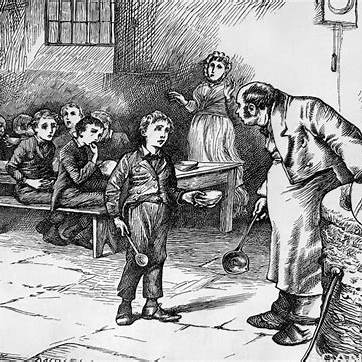
Jane’s act of rebellion against being unjustly locked in the red-room highlights a child’s struggle for autonomy in a society that expected obedience. Her resistance reflects a broader reality: children often had little voice or protection in Victorian England.

Real-World Connection (1840s – Children)

During the 1840s, child labor was widespread in Britain. Children as young as five worked long hours in textile mills, coal mines, and factories under harsh conditions, often punished if they resisted or slowed down.

A notable reform effort was the Factory Act of 1844, which limited children’s working hours and required safety measures. Still, many children resisted unfair treatment, sometimes staging small “strikes” or refusing dangerous tasks. Like Jane, these children’s defiance highlighted their awareness of injustice, even when adults dismissed their voices.

Lightning, Galvanism, and Frankenstein

This commonplace book entry focuses on one of the pivotal scenes in Mary Shelley’s Frankenstein—Victor’s childhood memory of lightning striking and destroying an oak tree—and connects it to Luigi Galvani’s groundbreaking experiments with electricity. Together, these elements highlight the fusion of natural wonder, scientific discovery, and the dangers of unchecked ambition.

Novel

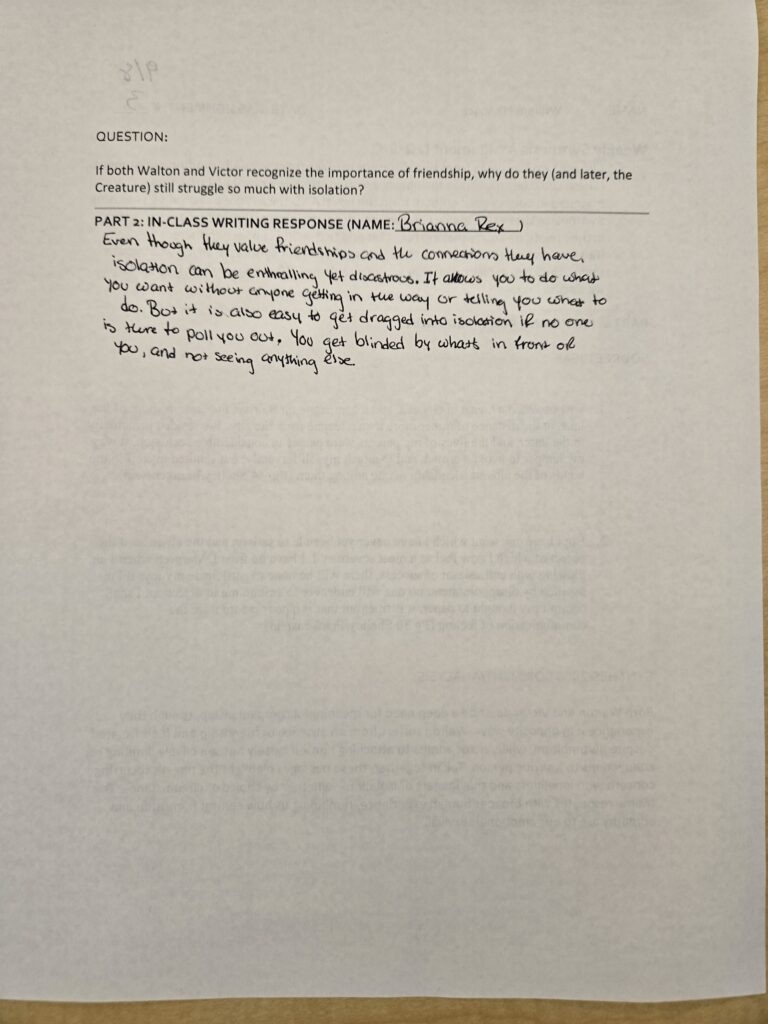
“As I stood at the door, on a sudden I beheld a stream of fire issue from an old and beautiful oak which stood about twenty yards from our house; and so soon as the dazzling light vanished, the oak had disappeared, and nothing remained but a blasted stump. When we visited it the next morning, we found the tree shattered in a singular manner; it was not splintered by the shock, but entirely reduced to thin ribbons of wood. I never beheld anything so utterly destroyed.” (Frankenstein, Volume I, Chapter II, 1818 edition)

Connection: This vivid image of nature’s destructive electricity profoundly impacts young Victor, foreshadowing his obsession with harnessing life through galvanism. The ‘blasted stump’ symbolizes both the awe-inspiring power of nature and the potential dangers of scientific ambition.

Historical Context: Luigi Galvani’s Experiments

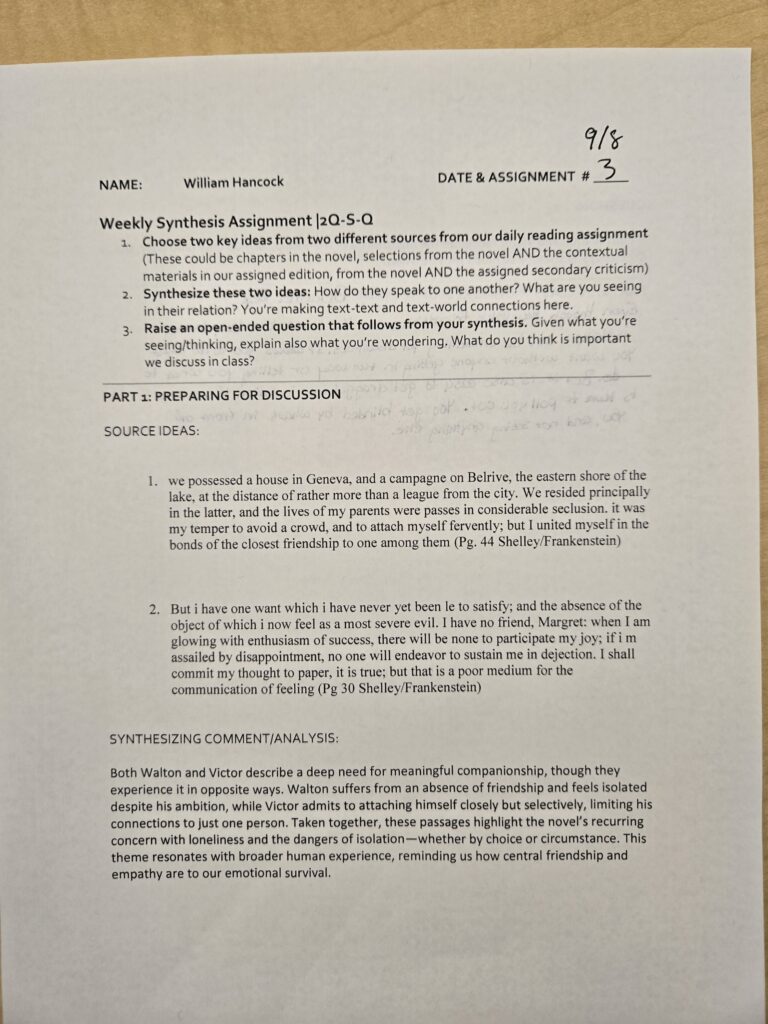
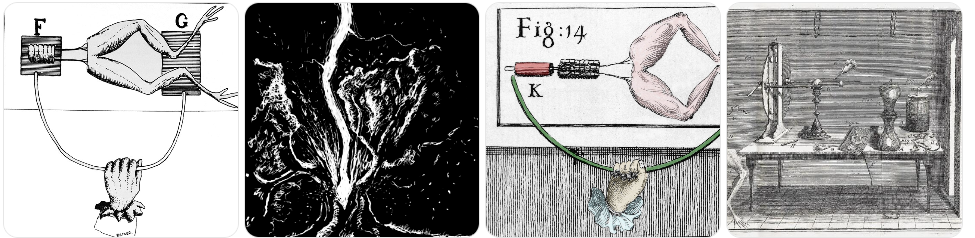
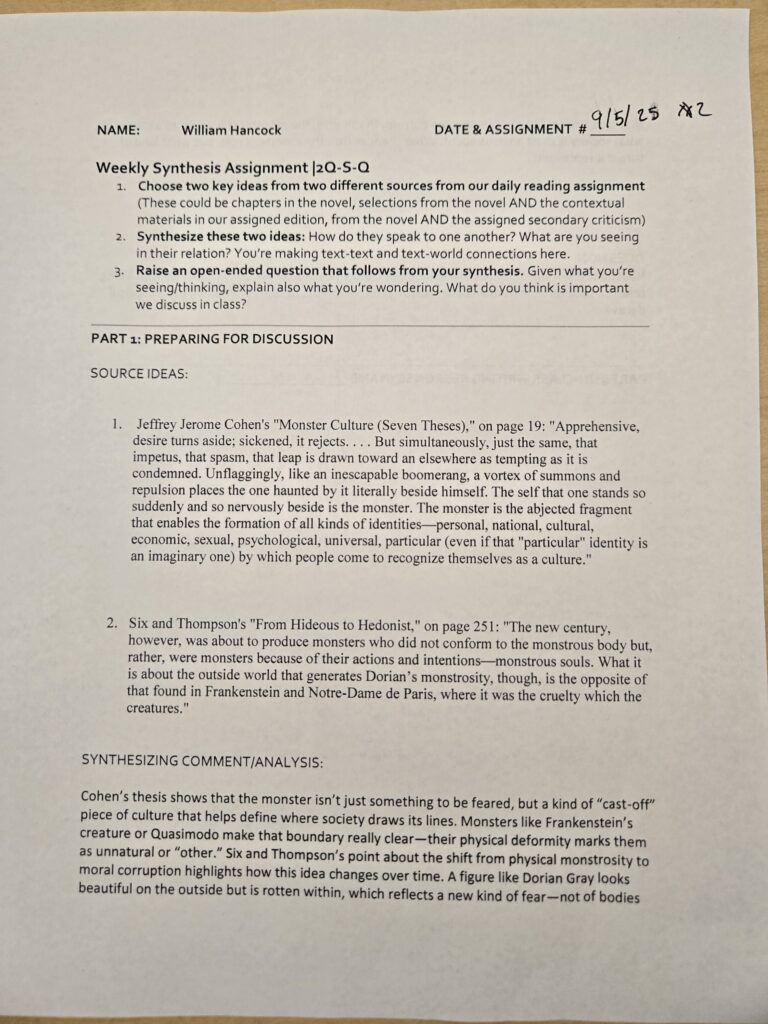
In 1791, Luigi Galvani published his observations on what he termed ‘animal electricity.’ During his experiments, he found that a frog’s leg twitched when struck by an electrical spark or when connected to different metals. Galvani interpreted this as evidence that electricity was intrinsic to life itself. These ideas sparked debates across Europe and laid the groundwork for the cultural fascination with electricity as a potential ‘spark of life.’

Connection: Galvani’s experiments anchor the novel’s scientific premise—lightning and electricity are linked not just to physical power but to the very possibility of reanimating life. Victor’s encounter with the lightning-struck tree echoes Galvani’s frog legs twitching under electrical influence, symbolizing nature’s secret—and dangerous—creative forces.

Visual Text

Below is a historical illustration of Galvani’s frog experiment, which shows how electricity could animate dead tissue. This image visually reinforces the connection between Victor’s lightning-struck tree and contemporary scientific exploration.

Common place book

What is a Commonplace Book?

A commonplace book is basically a place to collect things I find interesting or meaningful from our readings—quotes, images, notes, ideas—and organize them around themes. It’s not really a diary, more like a personal scrapbook or blog that helps me see connections between different texts, history, and ideas.

For me, this book is a space to explore the stuff that sticks with me while reading. I include passages from the texts, historical documents, images, and critical notes—anything that helps me think about the material in a deeper way.

The point isn’t just to copy things down—it’s to make connections between texts and the world around them. By putting different types of material together, I can notice patterns, recurring themes, or interesting contrasts.

Over the semester, this commonplace book will be both a record of what I read and a space to reflect. It’s a way to engage with the texts actively and build a collection of insights that actually mean something to me.

Frankenstein – M. Shelley

what is a common place book?

A commonplace book is a collection of quotes, images, notes, and ideas I’ve gathered and organized around themes in Frankenstein. It’s less like a diary and more like a personal blog or scrapbook that helps me make connections between the novel, historical context, and modern ideas.

When I first heard we had to make a commonplace book, I had to figure out what that even was. To me, it’s basically a mix between a journal and a scrapbook — but instead of personal stuff, it’s about pulling together quotes, images, and ideas from Frankenstein and its world.

For organization, I decided to focus on themes and use a variety of materials. Each entry will center around something big in the novel, like electricity, creation, or isolation. Then I’ll bring in at least two different types of material to go with it — usually a quote from the book, something from history or criticism, and sometimes a visual piece like an old illustration.

For example, my first entry is all about electricity and creation. I chose the scene where Victor sees lightning destroy an oak tree, and I paired it with Luigi Galvani’s frog experiments and an illustration showing how those experiments worked. Putting them together shows how Mary Shelley was drawing on the science and ideas of her time when she wrote about reanimation.

By setting it up this way, my commonplace book will build into a collection of themes that connect the novel to history and culture. That way, when I look back at it, I’ll have a bigger picture of what Shelley was doing with Frankenstein.

« Older posts

© 2026 William Hancock

Theme by Anders NorenUp ↑

css.php